Cited vs Recommended: The AI Visibility Distinction Every Brand Is Getting Wrong
Cited vs Recommended: The AI Visibility Distinction Every Brand Is Getting Wrong
Most brands now know, at least in principle, that AI tools like ChatGPT, Gemini, Claude and Google's AI Overviews are shaping how customers discover and choose what to buy. Fewer have noticed that "AI knows about us" and "AI recommends us" are two entirely different outcomes, measured in two entirely different ways.
This distinction, cited versus recommended, is the single most misunderstood idea in AI visibility right now, and it is quietly costing brands the ability to act on the data they do have.
What "cited" actually means
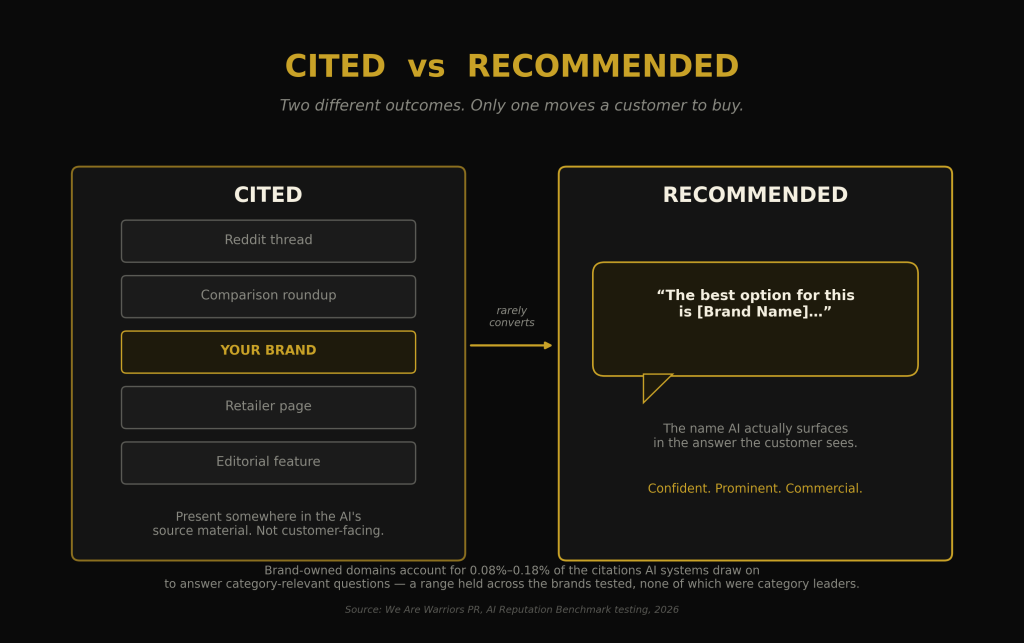
Being cited means a brand's name, product or website appears somewhere in the evidence an AI system draws on to construct its answer: a source URL in the background, a mention buried inside a longer list, a data point folded into a wider comparison. Citation is real. It means the brand exists inside the AI's source material at all.
It is not, on its own, commercial. A brand can be cited dozens of times across a category and still never be the name a customer actually sees, remembers or acts on.
What "recommended" actually means
Recommended is narrower and more valuable. It is the brand a customer sees named in the answer itself, ideally early, ideally with confidence, in response to the kind of question that leads directly to a purchase decision: "best foundation for acne-prone skin," "most reliable exfoliating acid for sensitive skin," "which of these is worth the price." Recommendation is the moment that actually moves a customer toward, or away from, a brand.
Every recommendation involves a citation somewhere upstream. Very few citations become a recommendation.
Why the gap between the two is measured so rarely
The industry's AI visibility conversation has mostly settled on a single, blunt question: does AI know we exist. Almost nobody is asking the sharper one: when AI does know a brand exists, does it actually say so to the customer, and how often.
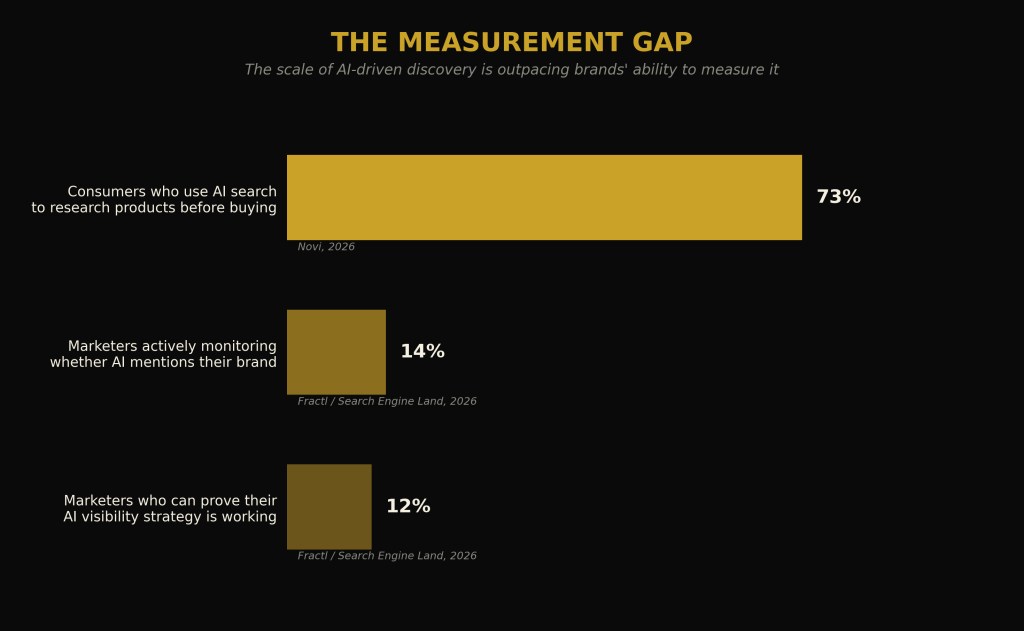
That gap in measurement is not a small oversight. Only 12% of marketers currently say they can prove their AI visibility strategy is working, and just 14% are monitoring whether AI tools mention their brand at all (Fractl/Search Engine Land, 2026). Most brands are not failing to close the cited-to-recommended gap deliberately. They do not yet have the instrumentation to see that the gap exists.
That would be a marginal problem if AI were a marginal channel. It is not. 73% of consumers now use AI search to research products before buying (Novi, 2026), ChatGPT alone reached roughly 900 million weekly active users as of February 2026 (OpenAI), and close to half of tracked Google searches now surface an AI Overview above the traditional results (BrightEdge, 2026). The moment a customer's question gets answered by AI, cited and recommended stop being an abstract distinction and start being the difference between a sale and a competitor's sale.
The Halo Leak: how a brand can be cited constantly and still rarely recommended
We Are Warriors PR's own cross-category research points to one of the clearest mechanisms behind this gap: the Halo Leak. This describes how multi-brand roundups and comparison content, whether pitched directly by a PR team or assembled independently by a journalist from separate single-brand coverage, build AI citation equity for the article itself, and for every named brand within it, not exclusively for the one that originally earned the placement.
Novi's analysis of 10.7 million ChatGPT beauty citations found that the single most-cited source, by a wide margin, was Reddit, followed closely by multi-brand editorial roundups (Novi, 2026). That is precisely the kind of content the Halo Leak describes: a brand sits inside the source material, genuinely cited, while the recommendation itself, the name AI actually surfaces first or with confidence, goes to whichever brand the AI's own weighting favours within that same piece.
Our own testing goes a step further. Across the categories tested, brand-owned domains accounted for between 0.08% and 0.18% of the citations AI systems actually drew on to answer category-relevant questions. That range held consistently across the brands tested, none of which were category leaders, which suggests this is closer to a structural feature of how AI sources its answers than a gap any single brand has simply failed to close.
Citation quality matters as much as citation volume
A related pattern shows up in how AI treats different kinds of credibility. 5W's Beauty AI Visibility Index found that a tier of brands built on ingredient transparency and clinical substantiation, rather than heritage or lifestyle positioning, accounted for an estimated 22% of all skincare AI citations tested (5W, 2026). Within that same research, Charlotte Tilbury held the highest cross-category citation share of any beauty brand tracked, and Rare Beauty, founded in 2020, already ranked second in makeup citation share, ahead of considerably older houses (5W, 2026).
The pattern is not that heritage or scale is penalised outright. It is that AI citation systems reward structured, verifiable proof more consistently than they reward reputation alone, which means citation quality, not just citation frequency, decides whether a brand's presence in the source material ever converts into an actual recommendation.
The Recommendation Gap: a strategic way to think about where a brand sits
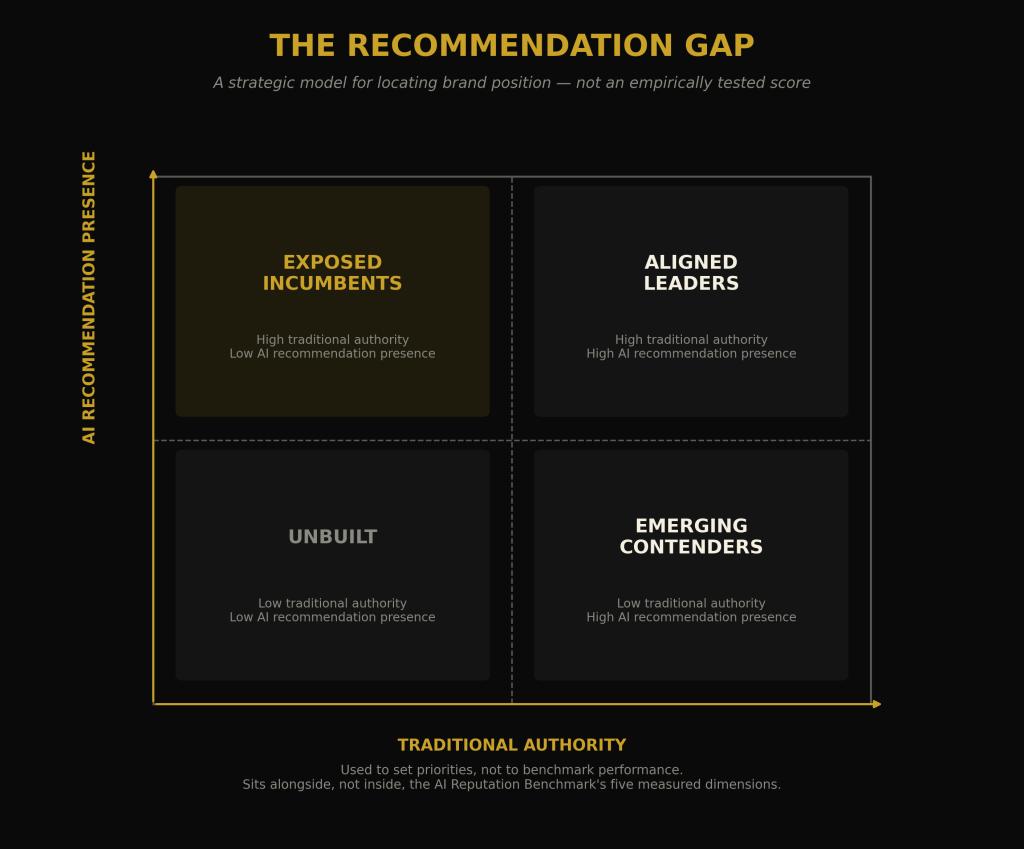
To help brands reason about their own position, we use a simple two-axis model we call the Recommendation Gap. It plots a brand's traditional authority, its established reputation, press history and category standing, against its current AI recommendation presence, how often it is the name AI actually surfaces rather than merely cites.
This produces four broad positions:
- Strong on both axes. Traditional authority and AI recommendation presence are aligned. The brand's reputation is translating into the AI answer as well as the human one.
- Strong traditional authority, weak AI recommendation presence. The brand most exposed to the cited-versus-recommended gap: well known, well covered, and still regularly passed over in the actual AI answer.
- Weak traditional authority, strong AI recommendation presence. A newer or smaller brand whose structured, citable content is already outperforming its traditional reputation inside AI answers.
- Weak on both axes. The brand has neither the traditional standing nor the structured proof points AI currently rewards.
It is worth being precise about what this model is and is not. The Recommendation Gap is a strategic framework for locating a brand's position and setting priorities, not an empirically validated scoring tool, and it does not sit inside the AI Reputation Benchmark's formal measurement dimensions. It is a way to think clearly about where the work needs to happen next, nothing more.
Measuring the distinction properly
This is exactly the gap the AI Reputation Benchmark was built to close, treating discoverability and recommendation as two separate, measurable outcomes rather than a single pass-or-fail state:
- Discoverability, whether a brand surfaces at all when AI is asked the category-relevant questions a real customer would type.
- Citation quality, whether a brand is cited on structured, verifiable grounds rather than general brand description.
- Trust signal density, the volume of certifications, expert backing and other verifiable proof points in a brand's own content.
- Competitive position, citation share relative to named competitors across the same set of prompts, tracked over time.
- Recommendation strength, how prominently and how confidently a brand is recommended when it does appear, rather than mentioned only in passing.
Reported as five separate dimensions, with no single blended score, because a brand that is cited constantly but rarely recommended, and a brand that is recommended occasionally but with real confidence, are facing two different problems that need two different fixes.
No AI reputation programme can promise a fixed position inside every future AI answer. What structured, verifiable content and a properly measured baseline can do is give a brand a clear, evidence-based view of where the cited-to-recommended gap currently sits, and a defensible starting point for closing it.
Closing the gap
Brands that have invested seriously in PR and reputation over the years are often the ones most surprised by this distinction, because their instinct, reasonably, is that strong coverage should already be doing this work. Strong coverage still matters. It builds the reach and trust that recommendation depends on. It was simply never structured to win the specific, ownable citation that AI rewards, and until that structural gap is measured directly, it stays invisible on every dashboard a board is likely to see.
FAQ
What is the difference between being cited by AI and being recommended by AI? Being cited means a brand's name or website appears somewhere in the source material an AI system draws on to build its answer. Being recommended means the brand is the name AI actually surfaces in the answer a customer sees, often early and with confidence. A brand can be cited frequently and still rarely recommended.
Why does my brand appear in AI's source data but not in its answers? This often happens because a brand's coverage sits mainly inside multi-brand content, such as comparison roundups, where the citation equity is shared across every brand named rather than accruing to one brand exclusively. It can also reflect a gap in the kind of structured, verifiable content AI weights when deciding which brand to name with confidence.
What is the Halo Leak? The Halo Leak describes how multi-brand roundups and comparison content, whether pitched directly by a PR team or assembled independently by a journalist from separate single-brand coverage, build AI citation equity for the article itself, and for every named brand within it, not exclusively for the brand that originally earned the placement.
What is the AI Reputation Benchmark? It is We Are Warriors PR's framework for measuring AI reputation across five separate dimensions: discoverability, citation quality, trust signal density, competitive position and recommendation strength. It is reported as five individual scores rather than one blended figure, because being cited and being recommended are different outcomes with different fixes.
Can a brand guarantee it will be recommended by AI? No AI reputation programme can promise a fixed outcome inside every future AI answer, since AI systems continue to evolve how they weight and surface sources. What a structured measurement baseline and targeted content work can do is close the gap between how strong a brand's reputation already is and how often that reputation actually surfaces in the answers customers see.
Want to know where your brand currently sits on the cited-to-recommended gap? Get your free AI Visibility Scorecard or book a call to scope a full AI Reputation & Visibility Audit with We Are Warriors PR.