What Is GEO, AEO and SEO? A Plain-English Guide for Marketing Leaders
The short answer
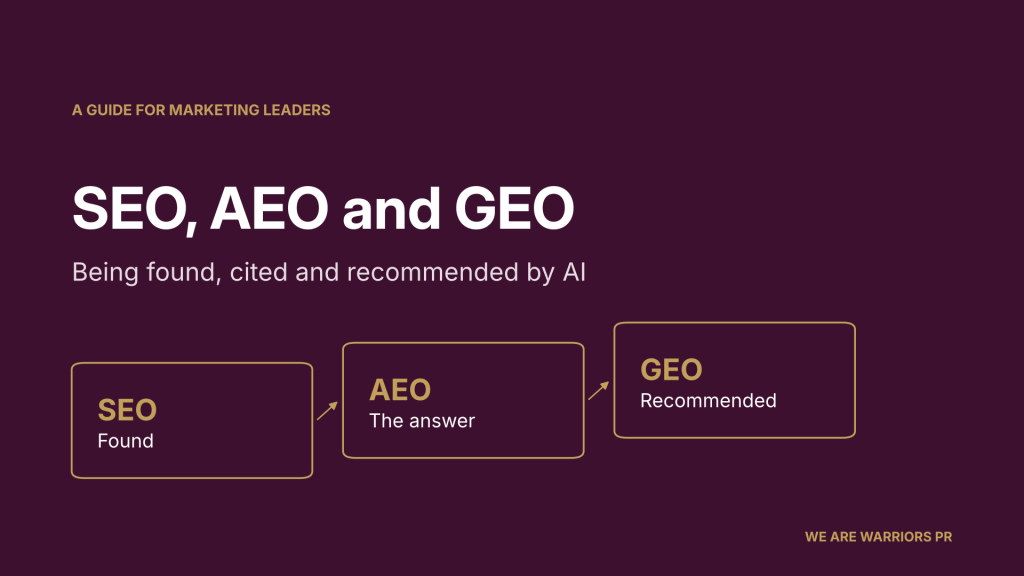
SEO, AEO and GEO are three related disciplines. Together they decide whether a brand is found when people look for information.
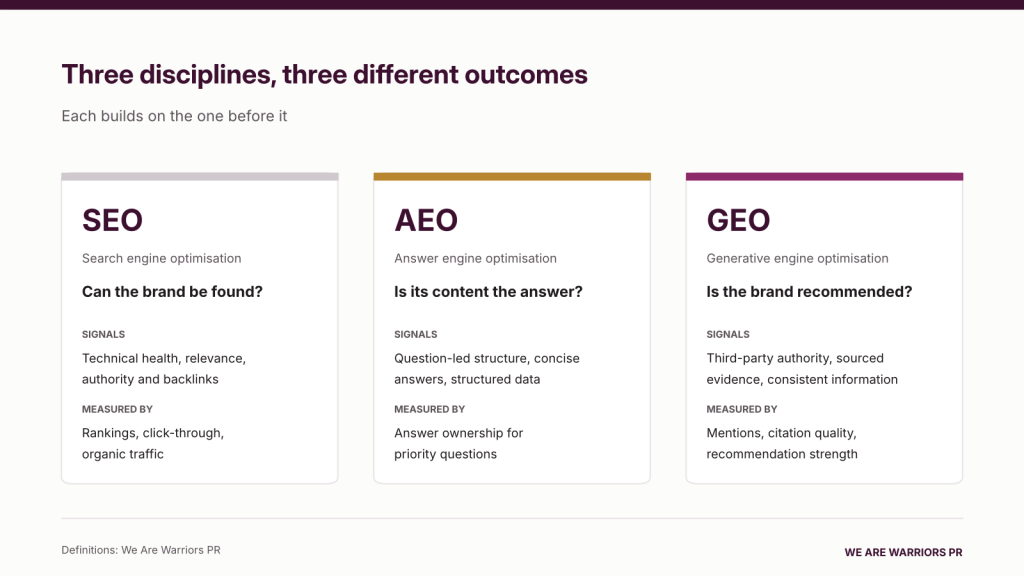
- SEO (search engine optimisation) improves how a website ranks in the organic results of search engines such as Google and Bing.
- AEO (answer engine optimisation) structures content so that search engines and assistants can present it as the direct answer to a question.
- GEO (generative engine optimisation) improves how often, and how favourably, a brand appears in answers written by generative AI systems such as ChatGPT, Gemini, Perplexity, Claude and Google's AI Mode.
Each discipline builds on the one before it. SEO earns a brand its place in the index. AEO makes its content easy to extract. GEO shapes how the brand is represented, and whether it is recommended, when an AI system writes the answer.
Why these terms now matter at board level
Generative AI is now a mainstream route to information. Google reports that AI Mode has passed 1 billion monthly active users since it expanded globally in October 2025. At its DevDay event in September 2026, OpenAI reported 1.2 billion weekly users across ChatGPT.
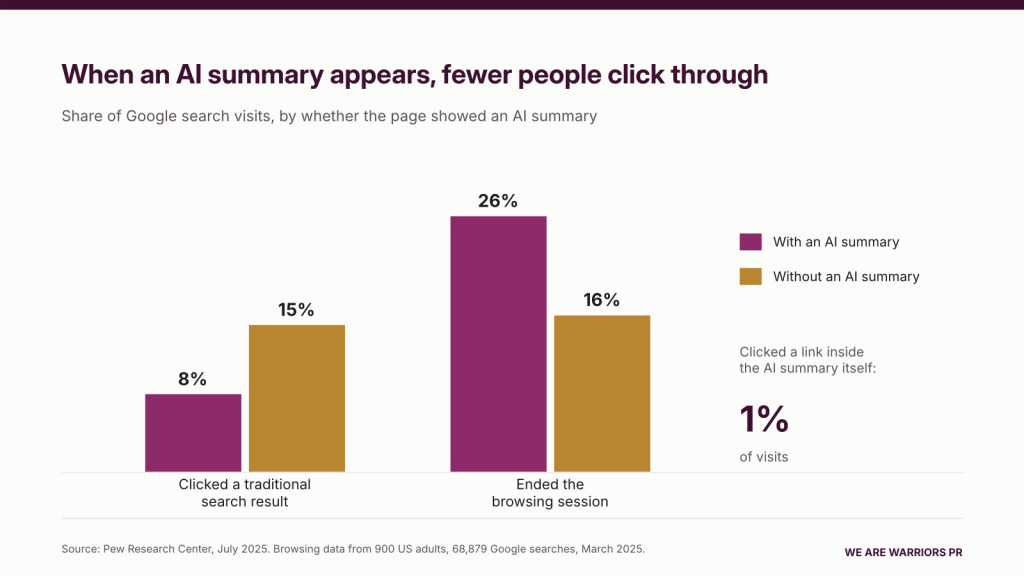
The consequence for marketing leaders is practical. Many questions that once produced a page of links now produce a written answer. That answer may name a handful of brands, or none.
What is SEO?
Search engine optimisation is the practice of improving a website's content, technical structure and authority so that it ranks higher in organic search results.
SEO rests on three foundations:
- Technical health: pages that load quickly, can be crawled and indexed, and work well on mobile.
- Relevant content: pages that match what people are searching for.
- Authority: links and mentions from credible external websites.
SEO is measured in rankings, click-through rate and organic traffic. It remains the foundation of the other two disciplines. Content that cannot be found and indexed is unlikely to be used in any answer.
What is AEO?
Answer engine optimisation is the practice of structuring content so that a search engine or assistant can lift it as the direct answer to a specific question.
AEO targets the formats where an answer appears before, or instead of, a list of links. These include featured snippets, "People also ask" boxes, voice assistant responses and AI-generated summaries at the top of a results page.
Effective AEO content usually has four features:
- A clear question as the heading, phrased the way people search.
- A concise, self-contained answer in the first one or two sentences.
- Supporting detail, examples and evidence after the answer.
- Structured data (schema markup), such as FAQPage and Article, that tells machines what each section contains.
AEO is measured by whether a brand's content is the answer shown for its priority questions.
What is GEO?
Generative engine optimisation is the practice of improving how often, and how favourably, a brand appears in responses written by large language model systems.
The term was formalised in a 2023 research paper, GEO: Generative Engine Optimization, by researchers from Princeton University, IIT Delhi and collaborating institutions. The paper was later presented at the ACM KDD 2024 conference. In the researchers' tests, adding citations, quotations from relevant sources and statistics to content increased its visibility in generated answers by more than 40% across a range of queries.
GEO differs from SEO in what it optimises for. A search engine returns a ranked list. A generative engine writes one answer, drawn from many sources, and decides which brands to mention, in what context and in what order. GEO is therefore concerned with four outcomes:
- Mention: whether the brand appears at all.
- Citation: whether the brand's own content, or credible coverage of it, is used as a source.
- Sentiment and context: how the brand is described.
- Recommendation: whether the brand is presented as a choice the user should make.
SEO vs AEO vs GEO: the key differences
SEO AEO GEO
Where it appears Organic search resultsFeatured snippets, voice answers, AI summariesAI-written answers in ChatGPT, Gemini, Perplexity, Claude and Google AI Mode
What it optimises for RankingBeing the extracted answerBeing cited and recommended
Primary signals Technical health, relevance, backlinksQuestion-led structure, concise answers, schemaThird-party authority, factual density, consistent information across the web
How success is measured Rankings, clicks, trafficAnswer ownership for priority questionsMentions, citation quality, recommendation strength
Where reputation fits
The most significant difference between GEO and its predecessors is how much of the evidence sits outside a brand's own website.
In our AI Reputation Intelligence Series research, brand-owned domains accounted for between 0.08% and 0.18% of AI citations, even for the strongest brands tested. The overwhelming majority of sources AI systems relied on were ones the brands did not own.
For this reason GEO sits as close to public relations as it does to search. Earned media, expert positioning and the consistency of a brand's story across third-party sources form a large part of the evidence base. It is also why established brands can be caught out. We describe the assumption that decades of brand equity carry over automatically into AI recommendation as the Heritage Trap. Heritage still matters, but it has to be documented in the sources AI systems use.
How to measure performance across all three
SEO has mature metrics. GEO does not yet. The answers AI systems give vary across models, prompts and time, so a single visibility score is too unstable to rely on.
Our AI Reputation Benchmark assesses brands across five dimensions:
- Discoverability: whether the brand appears for the questions its customers ask.
- Citation quality: the credibility of the sources used when it does.
- Trust signal density: the volume and consistency of credible evidence about the brand.
- Competitive position: how the brand is presented relative to competitors.
- Recommendation strength: whether the brand is presented as a choice, and how prominently.
Where marketing leaders should start
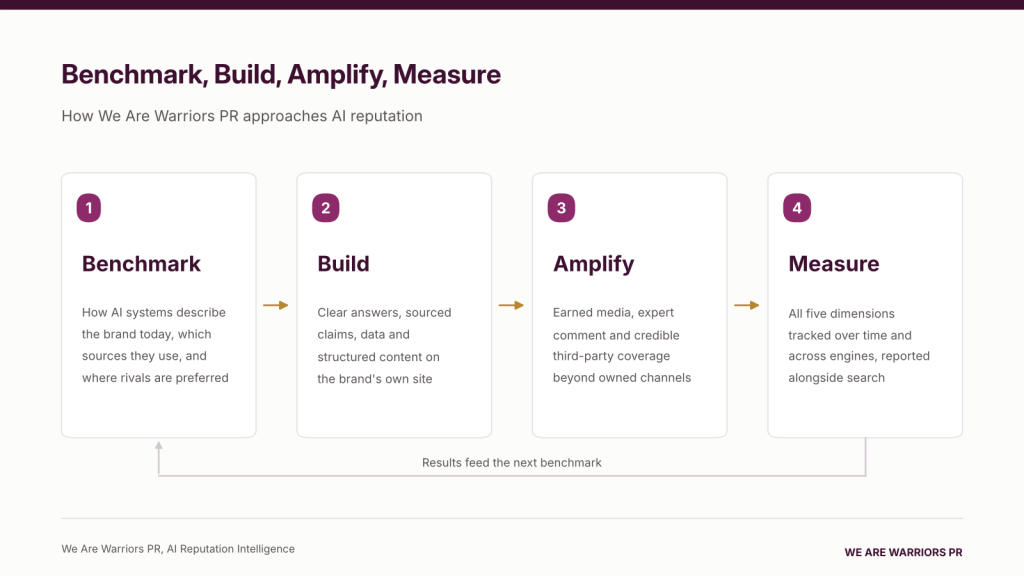
Our work follows four stages: Benchmark, Build, Amplify, Measure. The first matters most. Before investing in new content, establish how AI systems currently describe the brand, which sources they rely on and where competitors are preferred.
Practical first steps:
- Put your top 20 customer questions to the major AI assistants and record which brands are named.
- Audit priority pages for question-led headings, concise answers and schema markup.
- Map the third-party sources that shape your category and assess your presence in each.
- Align SEO, content and PR teams on one shared set of priority questions.
Get your free AI Visibility Scorecard
Book a confidential chat
Frequently asked questions
Is GEO replacing SEO?
No. SEO remains the foundation. Many generative systems retrieve live web content when answering, so content that is poorly indexed or poorly structured is less likely to be used. GEO extends the work into how a brand is represented across the wider web.
What is the difference between AEO and GEO?
AEO focuses on having a brand's content extracted as the direct answer to a specific question. GEO focuses on how the brand is represented across the whole AI-generated response, including whether it is recommended. The terms are often used interchangeably. We treat AEO as one component of GEO.
Can a brand influence what AI systems say about it?
Yes, through the evidence those systems draw on: the clarity of the brand's own content, the strength of its third-party coverage and the consistency of information about it across the web. No brand can dictate an AI system's response.
How is GEO measured?
Through repeated testing of the questions customers ask, across several AI systems, tracking mentions, citation sources, sentiment, competitive position and recommendation strength over time.
Who should own GEO inside a business?
GEO works best as a shared responsibility between SEO, content and communications teams, because the signals it depends on sit across all three.
About the author: Effie Kanyua is the founder of We Are Warriors PR, a London-based PR, crisis communications and AI reputation consultancy. She has more than 20 years of senior communications experience, including broadcast journalism at the BBC and Director-level roles at Hearst UK and Bauer Media. We Are Warriors PR was named Best Luxury Brand Reputation Communications Consultancy 2026 at SME News's Greater London Enterprise Awards.