Why Luxury Hotels Are Missing from AI Recommendations
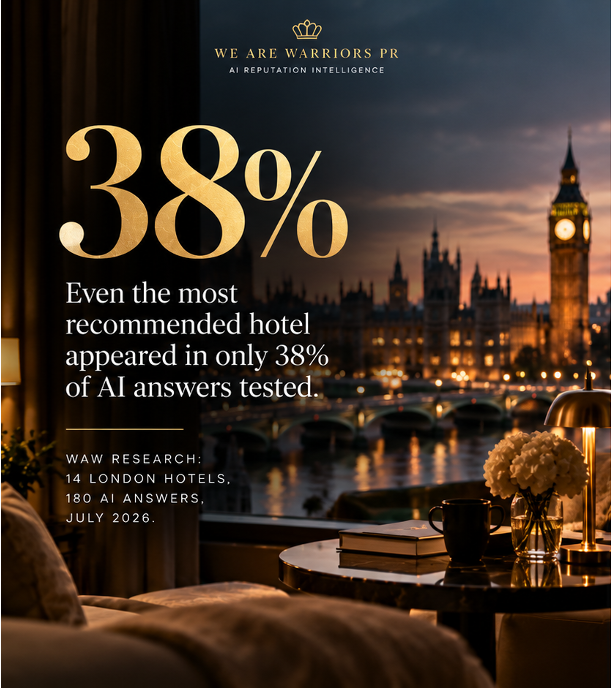
In brief: AI visibility for luxury hotels describes whether AI assistants such as ChatGPT, Gemini and Perplexity name a hotel when a guest asks for a recommendation. It is a different measure from search ranking or AI sentiment. In We Are Warriors PR research into 14 five-star London hotels (180 AI-generated answers, July 2026), AI described every hotel favourably, yet the most recommended hotel appeared in only 38% of answers and the most favourably described in only 13%.
AI described every hotel in our study favourably. It recommended them very unevenly.
In July 2026, We Are Warriors PR analysed 180 AI-generated answers to real guest questions, asked from the UK, about 14 five-star London hotels. Sentiment scores sat between 82 and 92 out of 100 for every hotel. Yet the hotel AI described most warmly appeared in only 13% of answers, and the gap between the most and least recommended hotel was 17-fold.
For a category that has spent decades building reputation through editors, awards and guest loyalty, that gap matters. A hotel can hold an excellent reputation and still be missing from the shortlist a guest receives before opening a single hotel website.
How AI is changing luxury travel discovery
Guests are increasingly putting the first question to an AI assistant. "Which luxury hotel in London is best for a special occasion?" "What are the best five-star hotels in London for a spa weekend?" "Which luxury hotels are best for corporate events?" The answer arrives as a short, confident list.
The adoption data is now substantial. More than half of British travellers (52%) use AI tools to support travel planning, up from 40% in 2025, according to MMGY Travel Intelligence's 2026 Portrait of European Travellers, a survey of 4,035 active leisure travellers across five European markets. ChatGPT is the most widely used platform among UK travellers, at 35%. In the US, Phocuswright reports that 56% of travellers used AI for planning, booking or in-destination help on at least one trip in the past 12 months, up from 33% in the first half of 2025.
The shortlist is also forming earlier. In L.E.K. Consulting's April 2026 survey of 2,650 US consumers, 31% of AI users said their purchase decision was largely made before they reached a brand or retailer site, up from 26% two years earlier. Travel was the category where AI was most widely used to inform purchases. These figures cover purchases in general rather than hotel bookings specifically, but they point the same way as the travel data.
Influence and traffic are different measures
Similarweb data published by Bain & Company in September 2026 shows that the share of hotel and short-term rental website traffic referred by AI platforms quadrupled between July 2025 and July 2026, yet remained under 1% of total visits. Adobe Digital Insights reports that AI-referred visits to US travel sites grew 194% year on year in May 2026, with sessions lasting 70% longer than other traffic, although those visitors still converted 28% less often.
Our reading of these figures together: AI's influence on hotel choice is far larger than the traffic it sends. Most of the decision happens inside the conversation, before any click a hotel can measure.
Why a strong reputation does not automatically translate into AI recommendations
Luxury hotel marketing has traditionally followed a simple chain: investment in brand, PR and digital builds reputation, and reputation drives bookings. AI adds a new step in the middle. Marketing investment now passes through AI interpretation before it becomes a recommendation, and only then a booking.
That interpretation step behaves differently from a human reader. An AI assistant builds its answer from the sources it treats as evidence, and those sources are mostly not the hotel's own. Across WAW's AI Reputation Intelligence Series, brand-owned websites accounted for between 0.08% and 0.18% of AI citations, even for the strongest brands tested. In the London study, 12 of the 14 hotels had their own website cited in fewer than one in 20 answers.
In practical terms, AI forms its view of a hotel largely from what others say about it.
What our London luxury hotel research found
Scope of the study
- Sample: 14 five-star hotels in London
- Method: 180 AI-generated answers to real guest questions, asked from the UK
- Period: July 2026
- Measures: recommendation rate, AI sentiment, and citation of each hotel's own website
The research is a focused category snapshot. It does not represent the UK hotel market as a whole, it does not establish why any individual hotel performed as it did and it did not test destinations.
Key findings
- No hotel dominated. The most recommended hotel appeared in 38% of answers, fewer than four in ten.
- The spread was wide. There was a 17-fold difference in recommendation rate between the most and least recommended hotels, all of comparable standing.
- Sentiment did not separate the hotels. Every hotel scored between 82 and 92 out of 100 for AI sentiment.
- The best-described hotel was rarely recommended. The hotel AI described most favourably appeared in 13% of answers.
- Hotel websites were rarely cited. 12 of 14 hotels had their own website cited in fewer than one in 20 answers.
Cited, well described, recommended: why these are different measures
These terms are often used interchangeably. They measure different things.
AI citation means a page was part of the source set an AI assistant drew on to build its answer. It shows a source is in the evidence base. It does not show the hotel was put forward.
AI sentiment describes how favourably AI characterises a hotel when it mentions it. In our study, sentiment was uniformly high and did not predict recommendation.
AI recommendation share is the proportion of relevant answers in which a hotel is named as a suggestion to the guest. This is the shortlist the guest sees.
AI-referred traffic is the visits that arrive on a hotel website from an AI platform. It captures only the guests who click, which current data suggests is a small minority.
Bookings and revenue are the commercial outcome. Evidence linking recommendation share directly to bookings is still emerging, and any claim of a direct revenue uplift from AI visibility should be treated with caution.
A hotel can be cited without being recommended, and recommended often without its own website ever being cited. We Are Warriors PR measures both, and treats recommendation share as the measure that matters commercially.
The Heritage Trap and the Halo Leak
Our work across luxury sectors has identified two structural reasons why well-regarded brands go unseen.
The Heritage Trap describes the gap between the reputation a luxury brand has built and the evidence AI looks for. AI systems tend to weigh structured, verifiable proof (verified guest experience, specific occasion and amenity matching, certifications) more heavily than heritage and lifestyle storytelling. A magazine editor responds to a brand world. A citation system responds to proof. Decades of brand equity do not carry across to AI answers by default.
The Halo Leak describes what happens when earned coverage appears in multi-hotel roundups such as "the best luxury hotels in London". That coverage builds AI citation equity for the article and for every hotel named in it, not only the hotel that secured the placement. Strong press can build a competitor's AI visibility as much as a hotel's own.
What the shift means commercially for hotel brands
The first consequence is a reporting blind spot. Coverage reports, search rankings and web analytics each miss the same thing. None of them shows how often a hotel is recommended against its competitors when a guest asks AI for advice. A hotel can perform well on every existing dashboard and still lose ground on the shortlist.
The second is accuracy risk. AI answers can carry outdated affiliations, closed restaurants, expired offers or positioning a hotel moved away from years ago. Without monitoring, these errors persist unnoticed.
The third varies by business model:
- Multi-property hotel groups face a different AI answer in every city, and a different one again depending on where the guest is searching from. The task is consistency of recommendation across the portfolio.
- Collections of independent luxury hotels need AI to connect each hotel to the collection and to what the collection stands for. When hotels join or leave, AI answers can lag.
- Members' brands with bookable rooms need AI to understand that non-members can stay, and to separate the hotel offer from the club. New openings begin with little or no AI footprint.
What this means for destination brands and tourism boards
This section is WAW's strategic analysis. Our July 2026 research covered hotels only and did not test destination queries.
Destination questions follow the same pattern as hotel questions. A guest asking "Where should I stay for a luxury weekend in Edinburgh?" or "Which destinations offer the best luxury wellness retreats in Europe?" receives a short list built from third-party sources, and the destination's own website is unlikely to be the main input.
We expect three implications for DMOs. First, destination and hotel visibility are linked: AI answers about a place often name the hotels within it, so a destination's AI reputation depends partly on its hotels' evidence base, and vice versa. Second, the Halo Leak works at destination level, as broad "best of Europe" roundups spread citation equity across competing destinations. Third, tourism boards are well placed to publish the structured, verifiable information AI tends to rely on (seasonality, accessibility, certified sustainability credentials, event calendars) in formats third-party sources pick up.
These are hypotheses to test, and a destination benchmark is the way to test them.
Where hotel brands should start
- Benchmark recommendation share against named competitors. Use the real questions guests ask in each priority market, tracked across the major AI platforms, before changing anything.
- Audit what AI says about you. Identify factual errors, outdated information and positioning gaps, and correct them at source.
- Strengthen structured, verifiable trust signals. Specific occasion and amenity detail, certifications and verified guest experience give AI something concrete to cite.
- Plan earned media with AI in mind. Identify the publications AI already cites for your category, and weigh single-property features against roundup placements that may benefit competitors.
- Give teams one shared metric. Recommendation share sits across PR, brand, digital and revenue, and gives all four a common number to report to the board.
How We Are Warriors PR helps and supports hotel brands
We Are Warriors PR is a London-based reputation and communications consultancy specialising in AI Reputation Intelligence. Our work combines more than 20 years of senior communications leadership, including Director-level roles at Hearst UK and Bauer Media, with original sector research.
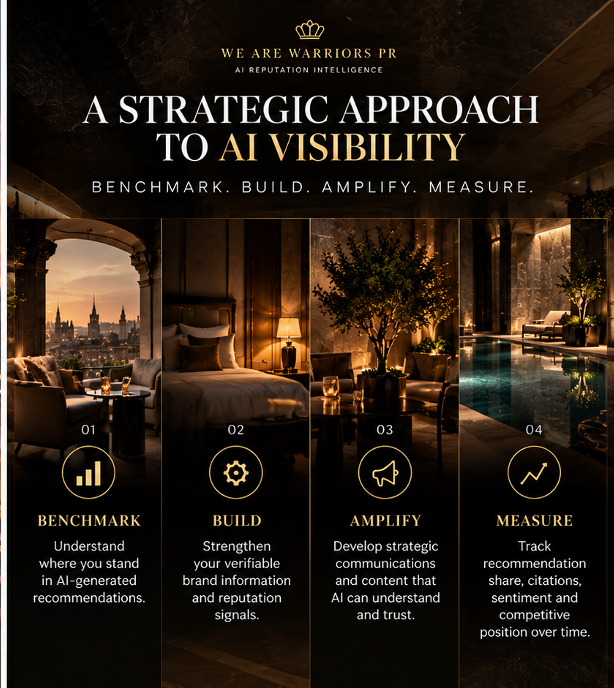
We work in four stages:
- Benchmark: establish how each property and its named competitors appear, or do not appear, in the AI answers guests are already receiving.
- Build: strengthen the structured, verifiable trust signals AI weighs most heavily.
- Amplify: earn presence in the specific sources and formats AI already trusts for the category.
- Measure: track recommendation and citation share against named competitors as a standing, reportable metric.
The work applies the communications expertise that built hotel reputations with editors to a new reader that now shapes the guest shortlist. No adviser can promise an AI recommendation. What we provide is a clear view of where a brand stands, why and what is most likely to improve its position.
Find out how AI recommends your hotel
Your existing reports will tell you how your hotel ranks, what was written about it and how many people visited the website. They will not tell you how often AI recommends you against your competitors, or what it says when it does.
An AI Reputation Intelligence Report benchmarks your property, or your portfolio, against named competitors on the questions your guests are asking, market by market. Speak to We Are Warriors PR to arrange a confidential scoping conversation.
Article FAQs
What is AI visibility for luxury hotels? AI visibility for luxury hotels is the extent to which AI assistants such as ChatGPT, Gemini and Perplexity name and describe a hotel when guests ask for recommendations. The most commercially relevant measure is recommendation share: how often the hotel is suggested against its competitors.
How is AI visibility different from SEO? SEO measures where a hotel's pages rank in search results. AI visibility measures whether an AI assistant puts the hotel forward in its answer. AI answers draw mostly on third-party sources, so a hotel can rank well in search and still be rarely recommended by AI.
Does a positive AI sentiment score mean AI recommends my hotel? Not necessarily. In WAW's July 2026 study of 14 five-star London hotels, every hotel scored 82 to 92 out of 100 for AI sentiment, yet the hotel with the most favourable sentiment appeared in only 13% of answers.
What is the Heritage Trap? The Heritage Trap is WAW's term for the gap between the reputation a luxury brand has built through heritage and storytelling, and the structured, verifiable evidence AI systems tend to weigh more heavily when deciding what to recommend.
What is the Halo Leak? The Halo Leak is WAW's term for the way multi-brand roundup coverage builds AI citation equity for every brand named, so a hotel's earned press can strengthen competitors' AI visibility as well as its own.
Can AI visibility work increase hotel bookings? AI-referred traffic is growing quickly but still accounts for under 1% of hotel website visits, and evidence linking AI recommendation share directly to bookings is still emerging. What can be measured now is whether a hotel makes the AI shortlist against its competitors, the first step in any guest decision that starts with AI.
Does this apply to destinations and tourism boards? WAW's published research covers hotels. Our strategic view is that destinations face similar dynamics, because AI builds destination answers from third-party sources too. A destination benchmark would establish how a specific place performs.
Article sources
- We Are Warriors PR, London luxury hotel AI visibility research, July 2026 (14 five-star London hotels, 180 AI answers)
- We Are Warriors PR, AI Reputation Intelligence Series, 2026
- MMGY Travel Intelligence, 2026 Portrait of European Travellers, June 2026
- Phocuswright, "The fastest shift in travel behavior just became the default", March 2026
- L.E.K. Consulting, "Thanks to AI, Consumers Are Arriving at Brand and Retailer Sites Ready to Buy", July 2026
- Adobe, AI traffic to travel sites report, June 2026
- Bain & Company, "Travel Operators Can't Just Watch as AI Reroutes the Customer Journey", September 2026